The Holiday Gift Card Playbook for Local Businesses
When to launch, what to charge, where to sell and what the VAT rules say. A plan for cafés, salons and shops that want December to pay off in January.
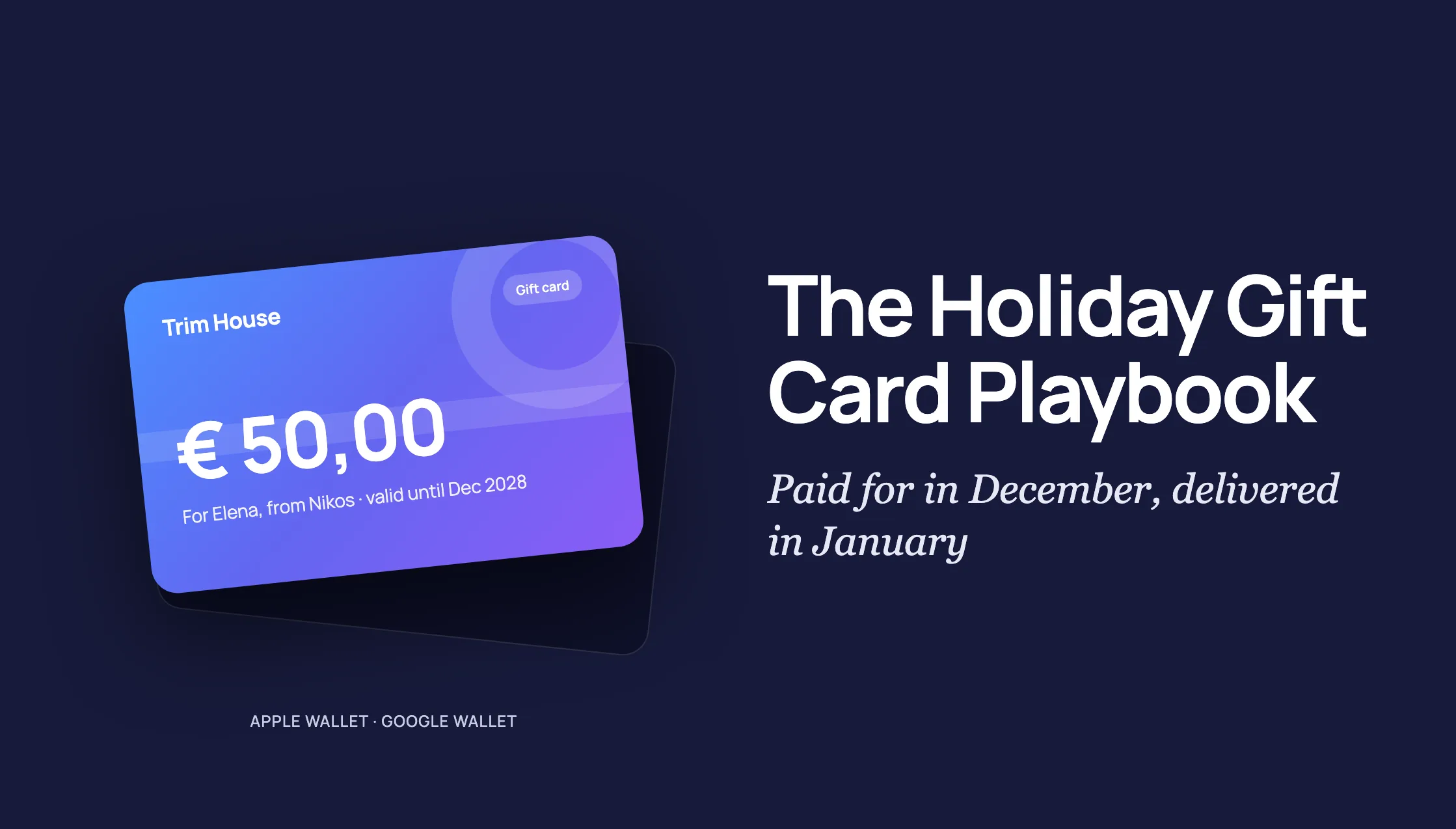
A gift card is the only thing a café, salon or shop sells that gets paid for in December and delivered in January.
The money arrives in the busiest month of the year. The visit happens in the quietest one. And the person who walks in with the card is usually someone who has never been in before, sent by someone who likes the place enough to give it as a present.
That makes the holiday season the one moment where a small gift card program earns its keep. This is a practical plan for it: when to launch, what to charge, where to sell, how to make January count, and the VAT rule that most guides skip.
Why gift cards work so well in December
Gift buyers want three things: something the recipient will like, no risk of the wrong size or flavour, and no shipping deadline. A gift card for a place the recipient already loves ticks all three.
It is also a popular gift, not a fallback. In Statista's November 2025 survey of UK consumers, vouchers and gift cards tied with clothing as the most wanted Christmas present.
For the business, the economics are simple. The amount is paid upfront. A share of recipients spend more than the card's value on the day they use it. And every redeemed card is a first visit you did not have to advertise for.
The calendar: three moments that matter
Holiday gift card sales do not arrive evenly. They come in three waves, and each one wants something slightly different from you.
- Late November. The Black Friday weekend brings planners and corporate buyers. They want to know the option exists, so the link and the counter sign need to be live before then.
- The first half of December. Gift lists get written. This is when a post, an email to loyalty members and a sign at the till do the most work.
- The last four days before Christmas. Shipping is over and last-minute buyers want something they can send tonight. A digital card delivered by email, with the recipient's name on it, is the product for this wave.
Then comes the fourth moment, which is January. Recipients redeem, and the real return on the program shows up as visits in a month that normally has few of them.
The practical rule: have everything working by mid-November. A gift card program that launches on 20 December misses two of the three waves.
Amounts and validity
Offer a few fixed amounts and one open amount. The fixed options should sit around your typical spend per visit. A barbershop with a 30 euro haircut sells 30 euro cards. A café sells 10, 25 and 50. The open amount catches the generous buyer and the corporate order.
Validity is where the law comes in, and it differs by market.
- Ireland: a gift voucher must be valid for at least five years, or have no expiry at all. The Consumer Protection (Gift Vouchers) Act 2019 applies to vouchers sold from 2 December 2019, and a shorter period is treated as five years.
- The Netherlands: a gift card must be valid for at least two years. The rule, in article 6:236 of the Civil Code, applies to cards sold from 1 January 2022.
- The United Kingdom: there is no statutory minimum. The expiry date must be clear to the buyer before purchase, and the common practice is one to two years or more.
- Greece: there is no specific gift voucher statute we could find. General consumer law applies, so state the validity clearly and generously.
Our advice is to not go near the minimum anywhere. Two years is a sensible floor in every market, and no expiry is simpler still. A card that expires in March does not make the customer come sooner. It makes them annoyed.
Loyaltree gift cards can be set to a validity in days or to never expire, and the expiry shows on the card itself so nobody is surprised.
Selling without the plastic
Plastic cards need to be printed, stocked, kept behind the counter and handed over in person. A digital card needs a link.
Put that link where the buyer already is: on your website, in your Instagram bio, on your Google Business Profile, and as a QR code at the till for the customer who thinks of it while paying. For a walk-in who asks at the counter, staff can issue a card on the spot.
The buyer pays online, writes the recipient's name, and the card is delivered by email. The recipient adds it to Apple Wallet or Google Wallet, where it sits next to their bank cards rather than in a drawer.
That last step matters more than it sounds. A card in a wallet app gets used. A code in an email from December gets forgotten. The pass also shows the current balance, so a card that was partly used in January still looks worth bringing back in February.
At the counter, staff scan the pass, enter the amount to redeem, and the balance updates on the customer's phone. Partial redemption is the normal case, not the exception, so the process should take seconds.
Redemption is the start, not the end
The gift card buyer was already a customer. The recipient is the new one, and January is your one chance to turn a single sponsored visit into a habit.
The simplest move is to invite every redeeming customer into the loyalty program at the moment they redeem. They already have their phone out and the wallet app open. A loyalty pass that goes in next to the gift card takes a few seconds, and the next visit is the one the program is built to bring back.
Then measure four things: how many cards you sold, how many have been redeemed, how many of those customers came back without a card, and how much balance is still outstanding. The first number tells you how December went. The other three tell you whether the program worked.
The VAT question nobody tells you about
Since 1 January 2019, the EU VAT rules distinguish between two kinds of voucher. The UK adopted the same split at the same time. The distinction decides when you owe VAT on a gift card, and a lot of small businesses get it wrong by accident.
A single-purpose voucher is one where the VAT rate and the place of supply are already known when the card is sold. A card that can only be spent on one service at one rate, in one country, is single-purpose. VAT is due when the card is sold, and the later visit is not a separate taxable event.
A multi-purpose voucher is everything else. A café card that can be spent on food at one rate and drinks at another is multi-purpose. So is almost every open gift card. No VAT is due when it is sold. VAT is due when it is redeemed, on the amount actually used, at the rate of whatever was bought.
This is also why Loyaltree does not print a VAT amount on a gift card purchase. The buyer gets a receipt for the amount paid. The tax position belongs to the business and its accountant, and it depends on what the recipient eventually buys.
The checklist
- Gift cards live and purchasable online by mid-November.
- Three fixed amounts around your average spend, plus an open amount.
- Validity of two years or more, or no expiry, stated on the card.
- The link on your website, social profiles and Google Business Profile, and a QR code at the till.
- One email to loyalty members in the first week of December, one post in the second week, one reminder on 22 December.
- Staff know how to issue a card at the counter and how to redeem one in seconds.
- Every redeeming customer is invited into the loyalty program.
- A note to your accountant about the multi-purpose voucher rule before the first sale.
None of this takes more than an afternoon to set up. The return shows up in two places: a better December, and a January with customers in it.
References & further reading
Legislation and data referenced above:
- Council Directive (EU) 2016/1065 on the VAT treatment of vouchers
- HMRC, “Changes to VAT legislation on face value vouchers”, VAT information sheet 09/18
- Government of Ireland, Consumer Protection (Gift Vouchers) Act 2019 information note
- Rijksoverheid, “Cadeaubon minimaal twee jaar geldig”, February 2021
- Statista, “Most desired Christmas gifts among UK consumers”, November 2025